You've got the artwork. You've chosen your t-shirt. Now comes another decision that can completely change how the finished garment looks:
Where should you put the print?
Front and back t-shirt printing can serve very different purposes. A small left-chest logo creates a completely different look from an oversized graphic across the back. And sometimes the best solution is to use both.
The right print placement depends on your design, brand, audience and how the t-shirt will actually be worn.
Here's what to consider before sending your artwork to print.
Why T-Shirt Print Placement Matters
Print placement isn't just a technical decision. It affects the entire look of your t-shirt.
The same logo can feel subtle and professional on the left chest, bold and promotional in the centre of the shirt, or completely different when incorporated into a larger back graphic.
Placement also affects visibility. If you're creating staff uniforms, you may want customers to identify your business quickly from the front. If you're producing streetwear or merchandise, a large back print might have much more impact.
Before choosing a position, ask yourself: what do I want someone to notice first when they see this shirt? That usually makes the decision much easier.
Front T-Shirt Printing
The front is probably the most familiar print position. It's immediately visible when someone approaches the wearer and works across everything from business uniforms to band merchandise.
But "front print" can actually mean several different placements.
Centre Chest Printing
A centre chest print places the artwork around the upper-middle area of the shirt. This is a versatile option for:
- Brand logos
- Illustrations
- Event artwork
- Promotional shirts
- Merchandise
- Slogans
- Graphic tees
The design can be relatively small and minimal or scaled up into a larger statement graphic. Centre placement naturally draws attention, making it useful when the artwork is the main feature of the shirt.
Left Chest Printing
A small left-chest print is one of the most common options for branded apparel. You'll often see it used for:
- Company logos
- Staff uniforms
- Trade workwear
- Hospitality uniforms
- Sports clubs
- Events
- Branded merchandise
The advantage is subtlety. Instead of turning the entire front of the shirt into an advertisement, the logo becomes a small branded detail. Left-chest printing also works particularly well when combined with a larger design on the back.
Full Front Printing
Want the artwork to dominate the shirt? A larger front print gives illustrations, photographs, typography and branded graphics much more visual impact. It's commonly used for:
- Streetwear
- Band merchandise
- Artist merchandise
- Fashion brands
- Promotional tees
- Event shirts
One thing to consider is how the artwork interacts with the garment itself. A design that looks great as a small chest print won't necessarily work when enlarged across the entire front. Artwork proportions and detail matter.
Back T-Shirt Printing
The back gives you a large area to work with and is ideal when you want the design to be seen from a distance. Back printing is particularly popular for merchandise, uniforms, events and streetwear.
Large Back Prints
Large back graphics have become a familiar feature of modern branded apparel and streetwear. They're useful when your artwork includes:
- Large illustrations
- Detailed graphics
- Typography
- Brand messaging
- Tour dates
- Event information
- Sponsor logos
- Website details
Because the back provides a relatively uninterrupted print area, you can often be more ambitious with the design.
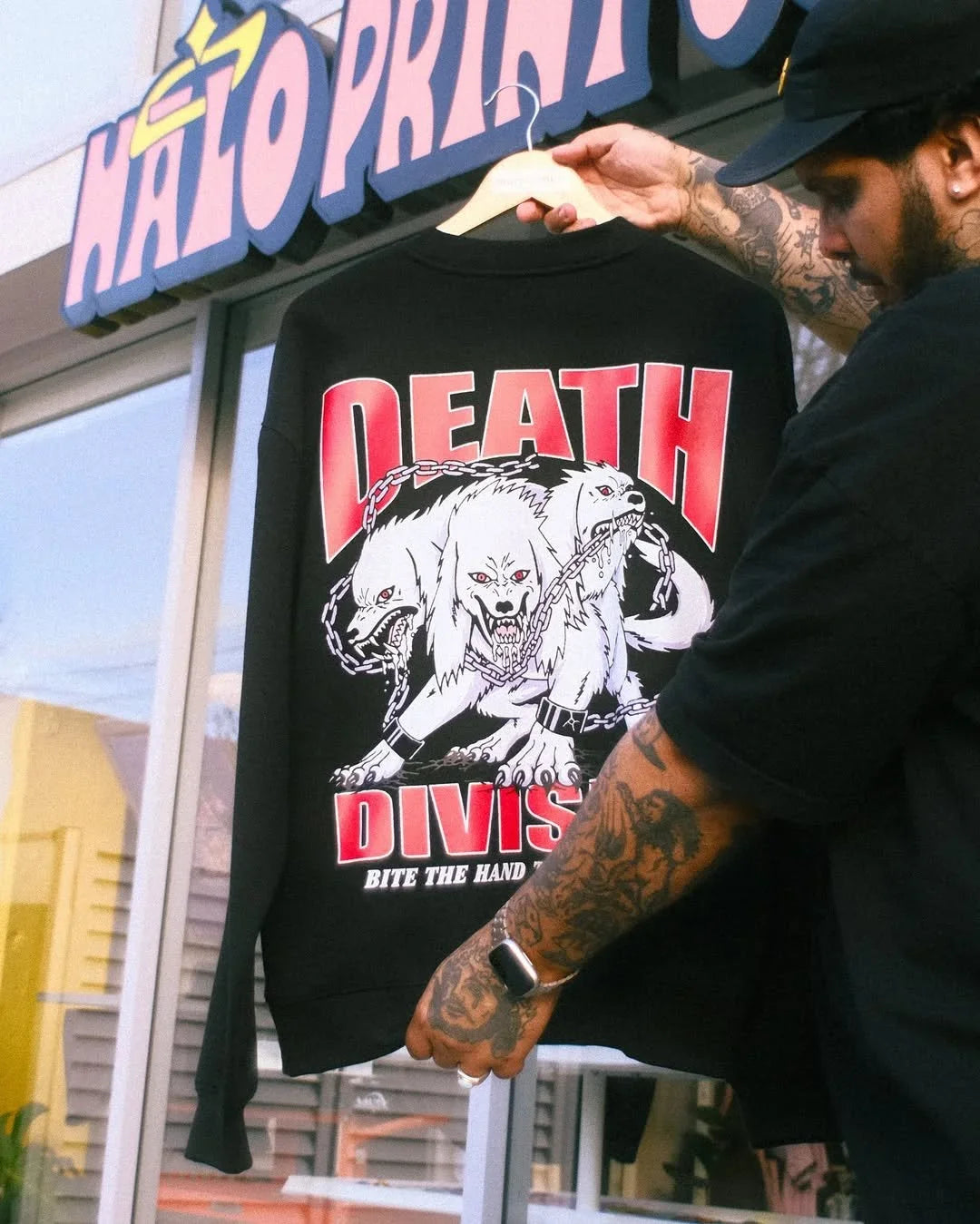
A common combination is a small left-chest logo on the front with a large statement graphic on the back. This gives you branding from both directions without making the front of the shirt feel too busy.
Upper Back Printing
Not every back design needs to be huge. A smaller print positioned across the upper back can work well for company names, websites, staff identifiers or short pieces of text. This placement is often useful for uniforms where identification is more important than creating a fashion-style graphic.
Front vs Back T-Shirt Printing: Which Is Better?
Neither is automatically better. It depends entirely on what you're trying to achieve.
- Choose front printing when you want your branding or design to be immediately visible during face-to-face interactions.
- Choose back printing when you want more space, greater visibility from a distance or room for a larger, more detailed design.
- Choose front and back printing when you want a complete branded garment with different information or artwork on each side.
For example, a landscaping business might use a small company logo on the front and larger contact details on the back. A clothing brand might use a small logo on the chest and a large illustration across the back. A sports club might put its crest on the front and sponsor branding on the back.
The purpose of the shirt should guide the placement.
Should You Print on Both the Front and Back?
Absolutely, if the design calls for it. Front and back printing gives you more space to communicate without forcing everything into one design. Popular combinations include:
- Small front logo + large back graphic
- Left-chest logo + company details on the back
- Front artwork + event information on the back
- Brand logo + sponsor graphics
- Small brand mark + oversized illustration
- Team logo + player or club information
However, more print positions also mean additional production requirements and generally affect the final cost. If you're working within a specific budget, prioritise the print position that matters most.
What About Sleeve Printing?
Sleeves are another option if you want to add an extra detail without changing your main artwork. Sleeve prints can work well for:
- Small logos
- Sponsor branding
- Social handles
- Short text
- Secondary brand marks
- Event details
They're particularly effective when the front and back are already being used. A sleeve logo can also give a basic branded tee a more considered, premium feel.
How Big Should a T-Shirt Print Be?
There isn't one perfect print size for every shirt. The right dimensions depend on the artwork, garment size, print position and overall aesthetic you're trying to achieve.
A small left-chest logo might only need a compact print area, while a statement back graphic could take up a significant portion of the garment.
Rather than thinking only in centimetres, consider the proportion of the design relative to the shirt. Something that looks balanced on a medium t-shirt may need adjustment when printed across significantly smaller or larger garment sizes. This becomes particularly important when ordering a broad size range for staff uniforms, events or merchandise.
Should Print Size Change Between T-Shirt Sizes?
Not necessarily. For many orders, the same artwork size is used across multiple garment sizes. This helps keep production consistent.
However, if your order ranges from very small children's garments through to large adult sizes, using exactly the same print dimensions may create noticeably different proportions. In these situations, it can be worth discussing whether multiple artwork sizes would produce a better result. Your printer can advise what's practical based on your garment range and printing method.
Print Placement for Business T-Shirts
For corporate apparel and staff uniforms, clarity usually matters more than creating the biggest possible graphic. A popular setup is:
- Front: small company logo on the left chest
- Back: larger company logo, tagline, website or service information
This keeps the front professional while making the business easy to identify from behind.
Trades and service businesses may benefit from a larger back print because employees are often seen working rather than standing face-to-face with customers. Hospitality businesses, retail stores and customer-facing teams may prefer simpler front branding.
Print Placement for Streetwear & Merchandise
For streetwear and branded merchandise, the rules are much more flexible. You can experiment with:
- Oversized back graphics
- Small centre-chest logos
- Left-chest branding
- Front and back combinations
- Sleeve details
- Typography
- Unusual print positioning
A small logo on the front paired with an oversized back graphic is particularly popular because it creates visual interest without overcrowding either side.
For merchandise, think about whether someone would actually choose to wear the design outside the event or business it represents. Often, less obvious branding and stronger artwork can make merchandise more wearable.
Print Placement for Events
Event t-shirts often need to communicate several things at once. You may have an event logo, sponsor logos, dates, staff identifiers and other information to fit onto the garment. Instead of squeezing everything onto the front, divide the information between different print areas. For example:
- Front: event logo
- Back: sponsor logos
- Sleeve: event date or secondary branding
This creates a cleaner result while still giving every required element a place.
Print Placement for Sports & Team Apparel
Team shirts and jerseys often require several different decoration positions. Depending on the sport or event, you might need:
- Club logo on the chest
- Sponsor logos
- Player names
- Numbers
- Sleeve branding
- Team name
- Event information
Planning all of these elements together is important. If each logo is added without considering the overall layout, the finished jersey can quickly start looking cluttered.
Does Print Placement Affect the Printing Method?
Sometimes. The garment, print location and artwork can influence which decoration method is most practical. At Halo Print Co, different projects may use methods such as:
Screen Printing
Screen printing is a strong option for larger quantities where the same design is being reproduced across multiple shirts. It works particularly well for bold front and back graphics.
DTF Printing
Direct to Film is flexible for detailed, full-colour designs and different print positions. It can be particularly useful when an order includes individual or more complex artwork requirements.
DTG Printing
Direct to Garment can produce detailed, full-colour artwork directly onto suitable garments and is a useful option for certain graphic t-shirt designs.
The right method depends on more than placement alone. Fabric, quantity, artwork and colour also need to be considered.
Common T-Shirt Print Placement Mistakes
Even good artwork can look wrong when it's positioned poorly. Some common problems include:
Printing Too Low
A chest design positioned too far down can make the shirt feel visually unbalanced.
Printing Too High
Artwork placed too close to the neckline can look cramped.
Making a Left-Chest Logo Too Large
A left-chest print is usually intended to be relatively subtle. Making it too large can create an awkward middle ground between a logo and a full front print.
Choosing a Huge Print Just Because You Can
Bigger doesn't always mean better. Some designs need negative space around them to have impact.
Ignoring the Garment
Pockets, seams, zippers, collars and different garment cuts can all affect available print areas. Your design should be planned around the actual garment, not just a blank rectangle on a computer screen.
Think About the Shirt as a Whole
One of the easiest mistakes when designing custom apparel is treating the artwork and garment as two separate things. They're not. The colour, cut and weight of the shirt are part of the design. So is the print position.
A heavyweight oversized tee with a large back graphic creates a completely different result from a fitted shirt with a small embroidered chest logo, even if both use exactly the same branding.
Before printing, think about the complete garment rather than simply asking where your logo will fit.
Front vs Back Printing FAQs
Is front or back printing more popular?
Both are common. Front printing is widely used for logos and standalone graphics, while larger back prints are popular for merchandise, uniforms and streetwear. Many designs use both.
Can I print on both sides of a t-shirt?
Yes. You can combine front and back printing, and sleeve printing may also be available depending on the garment and artwork.
Where should a logo go on a t-shirt?
A small company or brand logo is commonly positioned on the left chest or centre chest. The best position depends on the overall design and how the shirt will be used.
What is the best placement for a company t-shirt?
A small left-chest logo combined with larger branding on the back is a popular option for company uniforms. However, customer-facing businesses may prefer simpler front-only branding.
Can I have a large print on the back?
Yes. Large back prints work particularly well for illustrations, streetwear designs, event shirts and branded merchandise.
Does printing on both sides cost more?
Generally, yes. Front and back designs require multiple print positions, which usually increases production requirements compared with printing only one location.
Can you print on t-shirt sleeves?
Sleeve printing may be possible depending on the garment, artwork and printing method. It's commonly used for secondary logos, sponsors and smaller design details.
What files should I provide for t-shirt printing?
High-quality artwork produces the best results. Vector files are ideal for logos and graphics, while high-resolution raster artwork should be supplied at the intended print size wherever possible.
Need Help Choosing Your T-Shirt Print Placement?
Sometimes the easiest way to choose is to see your artwork on the actual garment. At Halo Print Co, we work with businesses, clothing brands, artists, events, sports teams and individuals across Sydney to create custom printed apparel.
Whether you're considering a small chest logo, oversized back print, front-and-back combination or something a little different, we can help you work out the placement and printing method that suits your design.
Ready to get started?
Ordering 26 or more? Get a price. Smaller order? Start a Quick Order. Want to talk it through? Book a consult.